The short version: The Instagram Basic Display API was shut down on December 4, 2024. If your WordPress Instagram feed runs on a personal Instagram account, it broke that day or has been showing stale content since. The fix is to switch your Instagram account to a Professional account (Creator or Business, both free, takes 30 seconds in Instagram settings) and reconnect through a maintained plugin like Spotlight. The Instagram Graph API is what every supported feed uses now, and there is no announced 2026 deprecation date.
If you’re already on a Business or Creator account, your feed is still working and nothing has fundamentally changed for you. The only ongoing maintenance is keeping your access token valid (most plugins handle this automatically; Spotlight does).
If you’ve been running an Instagram feed on your WordPress site for more than a year, you already know the drill. Meta changes an API, plugins scramble to keep up, and somewhere in the middle your feed stops updating until you figure out what broke.
The last big one was the Instagram Basic Display API shutdown on December 4, 2024. Feeds that relied on personal accounts went dark. A lot of site owners are still catching up to what that meant, and more are wondering what’s coming next.
Here’s the plain-English version of where the Instagram API stands in 2026, what you actually need to do about it, and how to keep your feed running no matter what Meta ships next.
What the Instagram API actually is
An API (“application programming interface”) is the set of rules that lets one piece of software talk to another. When you see an Instagram feed on a website, there’s an API call happening in the background that says, “Hey Instagram, can I have the last 12 posts from this account?” Instagram sends them back, the plugin displays them, everyone’s happy.
Instagram has offered a few different APIs over the years. The two that matter for this conversation:
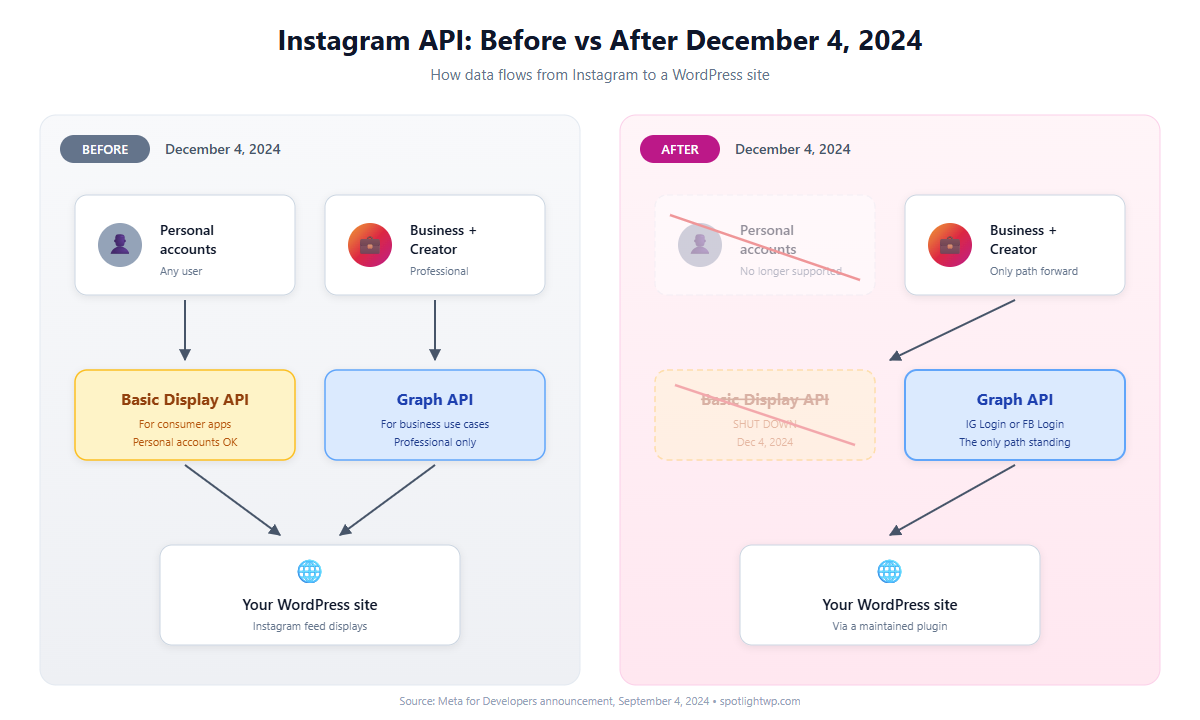
- The Instagram Basic Display API. Built for consumer apps. It could pull basic content (photos, videos, captions) from any Instagram account, personal or otherwise. This is the one that got shut down in December 2024.
- The Instagram Graph API. Built for businesses and creators. It’s more powerful, supports hashtag feeds and analytics, and requires a Professional account. This is the only API still standing for embedding Instagram content on a website.
If you want the official version, Meta’s developer blog announced the deprecation here. The short version: “After December 4th, 2024, there will no longer be a set of Instagram APIs for consumer developer apps.”
The Basic Display API shutdown (and why it still matters)
Meta announced the shutdown on September 4, 2024, giving developers exactly 90 days to migrate. On December 4, 2024, every Basic Display API request started returning an error.
If you were running an Instagram plugin on a personal account, that’s the day your feed stopped updating. The posts already embedded on your site stayed visible for a while (cached), but nothing new came through. Eventually a lot of those feeds broke entirely.
Here’s why this still matters in 2026: a surprising number of WordPress sites are still running on the assumption that their feed “just works.” It worked in 2023, it probably still works, right? Not always. If you haven’t checked your Instagram feed in a while, open your site in an incognito window and scroll to where the feed should be. A blank space, a stale post from 2024, or a generic error message all point to the same problem.
In our experience helping tens of thousands of Spotlight users migrate during the transition, the sites that got caught off guard were almost always the ones where the original feed was set up years ago and then forgotten about. It’s the kind of thing that never announces itself until a client notices.
Instagram API and WordPress in 2026: the current state
As of 2026, there’s only one path from Instagram to your WordPress site, and it’s the Graph API. But there are two different ways you (or your plugin) can authenticate against it:
1. Graph API with Instagram Login
This is the newer option Meta launched alongside the Basic Display deprecation. It lets Instagram Professional accounts connect directly to an app without requiring a Facebook page. If you don’t use Facebook, this is the path you’ll want.
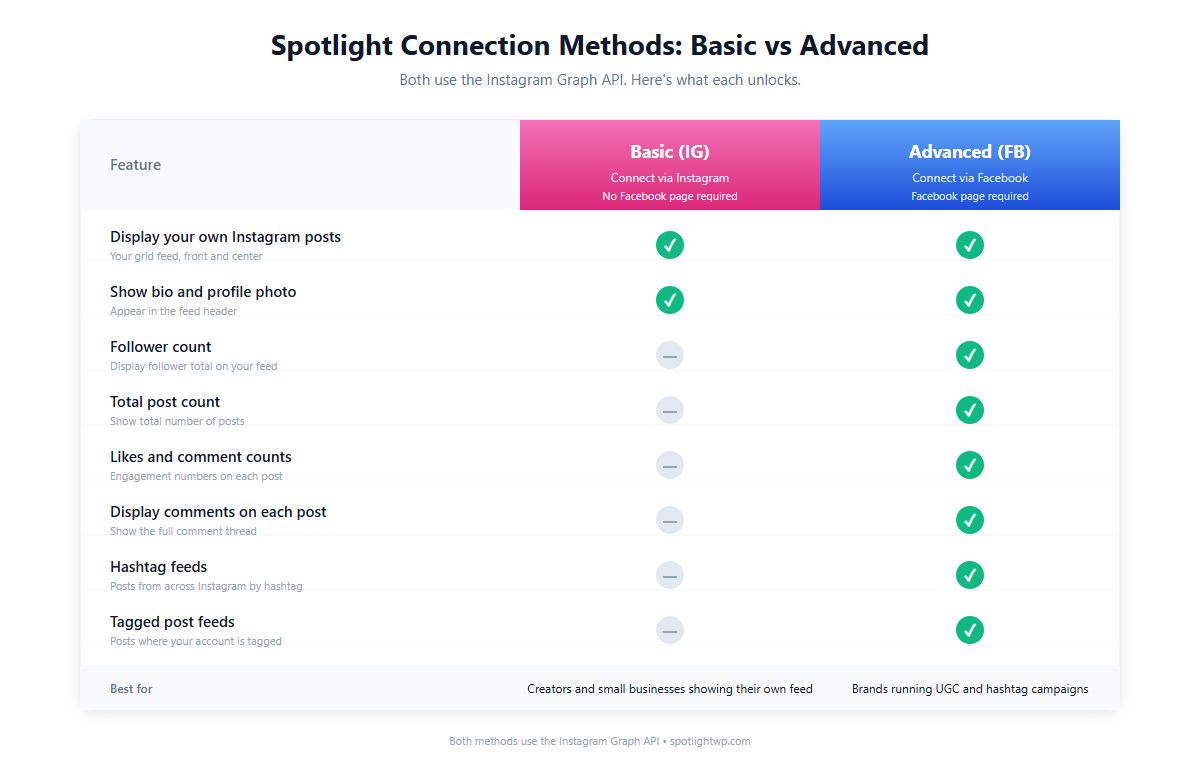
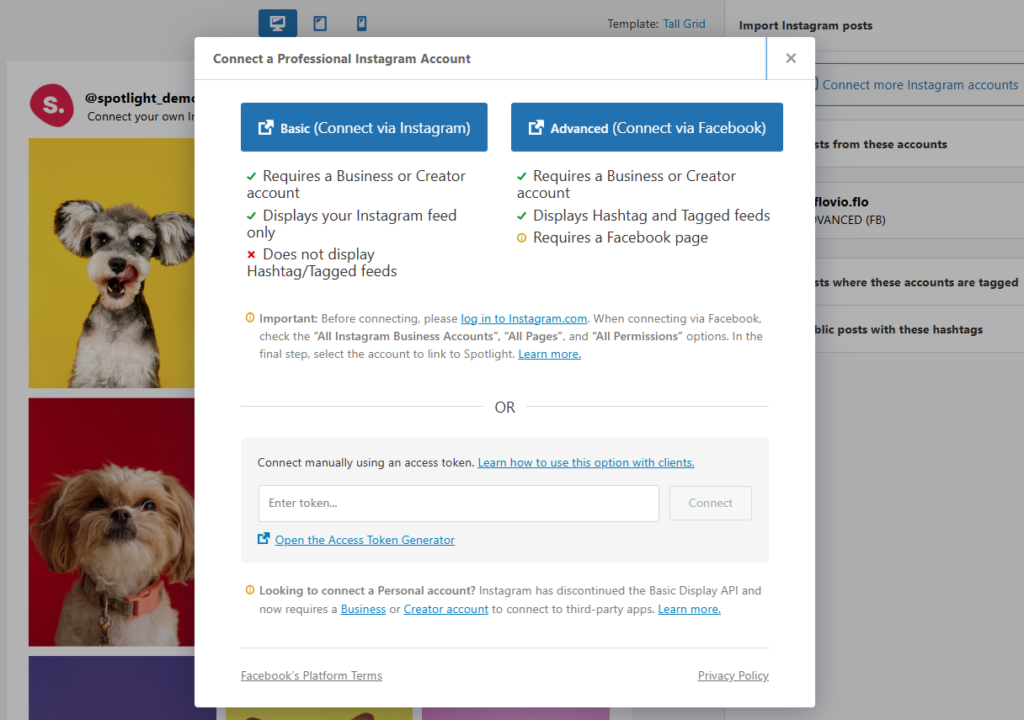
In Spotlight, this is called a Basic (IG) connection. It’s the simpler setup, and it covers most of what individual creators and small businesses need.
2. Graph API with Facebook Login
The original flavor. Your Instagram account has to be connected to a Facebook page, and you authenticate through Facebook. In exchange you unlock the more advanced features of the Graph API.
In Spotlight, this is called an Advanced (FB) connection. It takes a few extra steps but gives you access to:
- Hashtag feeds (posts from across Instagram that use a specific hashtag)
- Tagged post feeds (posts from other accounts that tagged you)
- Follower counts and total post counts
- Likes, comments, and comment display on each post
If you want to run a hashtag feed for a UGC campaign, you need the Advanced connection. If you just want your own posts on your homepage, the Basic connection is plenty.
What WordPress site owners need to do
Which bucket you’re in depends on how your site is set up today. Here’s a quick way to figure it out.
If your Instagram feed is already running on a Business or Creator account
You’re in the clear. The Graph API is what you’re already using, nothing has fundamentally changed for you, and your feed will keep updating as long as your access token stays valid (more on that in a second).
The one thing worth doing: log in to your plugin’s settings and confirm the account is still connected. Tokens occasionally expire, especially if you’ve changed your Instagram password or revoked app permissions somewhere along the way.
If your feed is pulling from a personal account (or broke in late 2024)
This is the group that needs to act. The fix is actually straightforward:
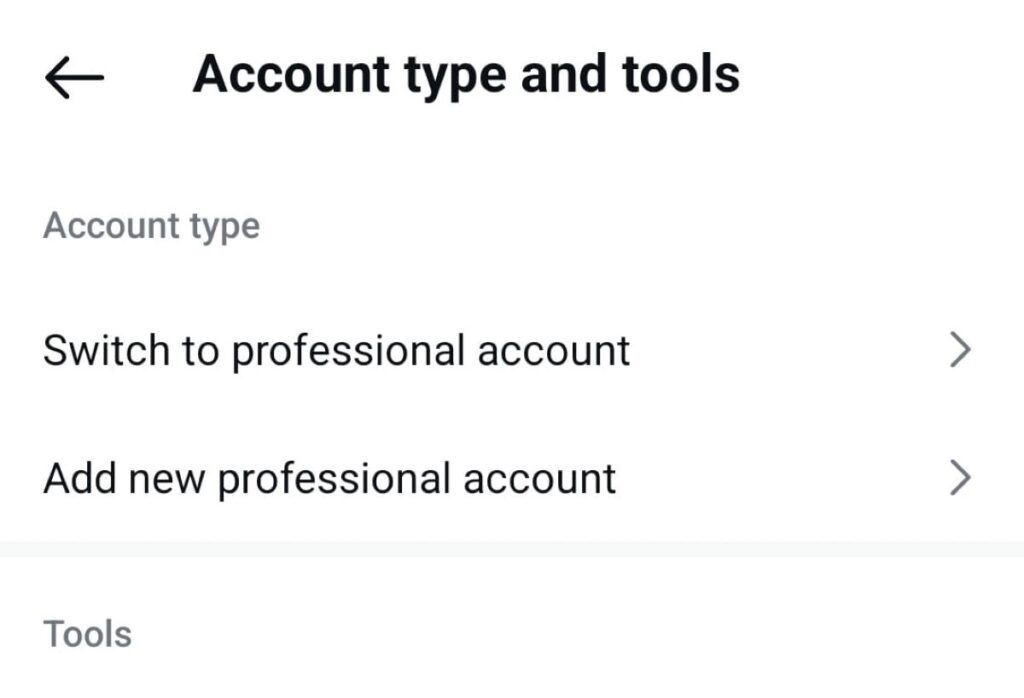
- Convert your Instagram account to a Professional account. Open the Instagram app, go to Settings, tap “Account,” and choose “Switch to Professional Account.” Pick Business or Creator depending on your preference. Both work with the Graph API. This is free, and nothing on your public profile changes unless you want it to.
- Reconnect the account to your plugin. Inside your Instagram feed plugin’s settings, you’ll see a “Connect” button. Click it, authorize the connection, and your feed should start pulling posts again within a few minutes.
- Decide between Basic and Advanced. If you want hashtag feeds or UGC features, go with the Facebook-based Advanced connection and link a Facebook page to your Instagram account first. Otherwise, Basic is fine.
If you built your own Instagram integration (no plugin)
First of all, respect. Second, you already know the drill: you’ll need to register an app in the Meta for Developers dashboard, implement the OAuth flow for either Instagram Login or Facebook Login, and handle token refreshes on your own. Meta’s Instagram API documentation is where to start.
For most WordPress site owners, this is the long way around. A plugin does the same work in two clicks.
The access token question, explained simply
Every search for “Instagram access token” on Google leads to a rabbit hole of developer tutorials, Graph API explorer screenshots, and abandoned token generator websites. So let’s cut through it.
An access token is basically a key. When your plugin wants to fetch posts from your Instagram account, it sends a request to the Graph API with this key attached. Instagram checks the key, confirms you authorized it, and sends the posts.
Here’s what most tutorials don’t make clear:
- You don’t need to generate a token yourself if you’re using a plugin. The plugin handles it during the “Connect” flow. One click, done.
- Manual token generators are risky. A lot of the free “Instagram access token generator” sites that pop up in search results are either defunct or ask you to grant their app access to your Instagram account. That’s a permission you probably don’t want to hand out to a random third party.
- Tokens expire. Long-lived Graph API tokens last 60 days and need to be refreshed. A good plugin refreshes them automatically. If you’re DIYing it, you’ll need to build that refresh logic yourself.
Here’s the thing: the question “how do I get an Instagram access token for WordPress” is almost always the wrong question. The right question is “how do I get an Instagram feed on WordPress without worrying about tokens at all?” That’s what a plugin is for.
Three Instagram API myths you’ll run into online
Type “instagram api wordpress” into Google and you’ll find a lot of advice that was true three years ago. A few persistent myths worth clearing up:
Myth 1: “You can still use a personal Instagram account with the right plugin.”
No. Since December 4, 2024, there is no official API path for personal accounts. Any plugin claiming to work with personal accounts today is either scraping public pages (which violates Instagram’s terms of service and breaks often) or quietly failing without telling you.
Myth 2: “You need to pay Meta to use the Graph API.”
No. The Graph API is free. Meta makes its money from ads and commerce, not from API calls. You pay for the plugin (or your own development time), not for the data.
Myth 3: “Switching to a Business account will mess up my account or reset my followers.”
No. Switching is a setting change. Your username, followers, posts, captions, DMs, and bio all stay identical. You can switch back to a personal account any time with no data loss. The only visible change (optional) is a “Contact” button on your profile.
How Spotlight handles the API for you
We built Spotlight to be the plugin that takes the API stuff off your plate. That’s its whole job. When Meta changes something, we update the plugin. When tokens need to refresh, the plugin refreshes them. When a new connection method shows up (like the Instagram Login option we added when Basic Display was deprecated), we roll it in.
Setting up a feed looks like this:
- Install the free version of Spotlight from the WordPress plugin directory.
- Click “Connect” and choose either the Basic (IG) or Advanced (FB) option.
- Authorize the connection in the Instagram or Facebook popup.
- Customize your feed in the live preview.
- Drop the shortcode or block into any page.
The whole thing takes about five minutes. No tokens to copy and paste, no app to register, no developer dashboard to navigate.
If you want the full tutorial with screenshots, we’ve written a step-by-step guide to adding an Instagram feed to WordPress that walks through every step.
A few things worth knowing about the free version specifically:
- It supports unlimited feeds and posts per feed.
- It includes all the core layout options (grid, masonry, highlight).
- It works with both Basic and Advanced connection methods.
- Hashtag feeds, tagged-post feeds, shoppable feeds, and Link in Bio pages are part of Spotlight PRO.
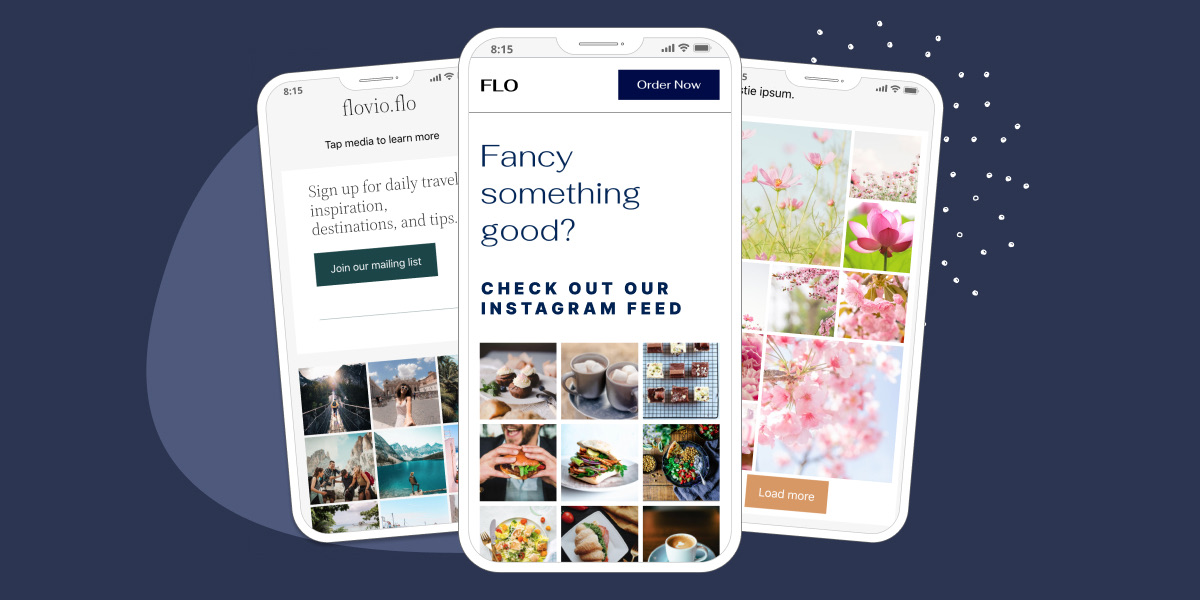
For most sites, the free version is enough to get a clean Instagram feed up and running. Here’s what a Spotlight-powered feed looks like in the wild:
What could change next
Nobody outside Meta knows what the 2026 roadmap looks like. But based on how the platform has evolved, a few things are worth watching.
Tighter rate limits and permission reviews. Meta has been methodically reducing the surface area of what third-party apps can do on Instagram. The Basic Display deprecation fits that pattern. Expect incremental tightening on things like how often data can be fetched and what permissions a new app gets by default.
More AI-driven content surfaces. As Instagram leans further into Reels and AI-generated recommendations, the API may surface new content types or deprecate older ones. Static photo grids aren’t the center of gravity they used to be.
Stricter enforcement on personal-data use. Regulations like the EU’s Digital Markets Act and ongoing scrutiny from US regulators are pushing Meta to be more conservative about what third-party developers can access. That trend is unlikely to reverse.
None of this is a reason to panic. It’s a reason to pick tools that are actively maintained. A plugin that had its last update two years ago is not the one you want standing between you and the next API change.
Is the Instagram API still working in 2026?
Yes. The Instagram Graph API is fully supported and is what powers every WordPress Instagram feed plugin in 2026. The Basic Display API (the older, simpler one) was deprecated on December 4, 2024 and is no longer accepting requests. If your feed broke after that date, switching to a Professional account and reconnecting through your plugin restores access via the Graph API. For a step-by-step setup walkthrough, see our guide to adding an Instagram feed to WordPress.
What replaced the Instagram Basic Display API?
The Instagram Graph API. It supports Business and Creator accounts (Personal accounts are no longer eligible). It does everything the Basic Display API did (display photos, videos, profile info) plus hashtag feeds, tagged-post feeds, and analytics that the Basic Display API never supported. For a comparison of plugins still maintained against the Graph API, see our 2026 plugin comparison.
How do I fix an Instagram feed that stopped working in late 2024?
- Open Instagram settings on your phone, go to Account type and tools, and switch your account to Creator or Business (both free).
- In your WordPress plugin’s settings (Spotlight, Smash Balloon, etc.), disconnect the broken account and reconnect. The plugin will route through the Graph API automatically.
- Confirm the feed updates with a new post.
If the feed still doesn’t show up after reconnecting, the next thing to check is your access token. Spotlight’s access token generator walks you through getting a fresh one without touching the Facebook Developer dashboard.
FAQs
Is the Instagram Basic Display API really gone?
Yes. It was shut down on December 4, 2024. All requests to it now return errors. There’s no plan announced to bring it back.
Will switching from a personal to a Professional account change how my Instagram looks to followers?
No. Your posts, followers, username, and bio all stay exactly the same. The switch is purely a setting on the account, and you can switch back anytime if you change your mind.
Do I need a Facebook account to use the Instagram Graph API?
Not necessarily. The newer “Instagram Login” option lets Professional accounts connect without a Facebook page, though you’ll lose access to hashtag feeds and a few other Advanced features. If those matter to you, yes, you’ll need a Facebook page linked to your Instagram account.
What’s an Instagram access token, and where do I get one?
A token is the credential your plugin uses to authenticate with the Instagram API. If you’re using a plugin like Spotlight, you don’t need to generate or manage it yourself. The plugin handles it during the connection flow. If you’re building a custom integration, you generate it through the Meta for Developers dashboard.
My Instagram feed plugin isn’t updating anymore. What do I do?
First, check if the plugin is still actively maintained. Go to its WordPress.org page and look at the “Last updated” date. If it hasn’t been updated in over a year, that’s almost certainly the problem. You’ll want to switch to a plugin that’s kept current with the Graph API. Beyond that, confirm your Instagram account is a Professional account (Business or Creator) and reconnect it through the plugin’s settings.
Can I display Instagram posts on WordPress without an access token?
Not through any official, sustainable method. Some plugins claim to work “without a token” by scraping Instagram’s public pages, but that approach violates Instagram’s terms of service and breaks frequently when the site’s markup changes. The Graph API is the only reliable path, and it requires a token. The good news: a plugin generates and manages that token for you.
Does the Instagram API cost money?
No. Meta offers the Graph API for free, with rate limits that are more than enough for a typical WordPress site. You’re only paying for the plugin (or your own development time), not for the API calls themselves.
How often does Spotlight fetch new posts from Instagram?
By default, Spotlight caches the feed and refreshes it periodically in the background so your site loads fast and you don’t hit API limits. You can adjust the refresh interval in the plugin settings if you want it quicker.
The takeaway
The Instagram API has been a moving target for years. It’s probably going to keep moving. But the core job for WordPress site owners is the same as it’s always been: show your Instagram content on your site, keep it fresh, and don’t spend your afternoons troubleshooting developer documentation.
If your current setup survived the Basic Display shutdown, you’re probably fine. If it didn’t, switching to a Professional account and reconnecting through a maintained plugin is a twenty-minute fix. And if you haven’t set up an Instagram feed yet, the 2026 version of this is the easiest it’s ever been to get right on the first try.
Have questions about the Instagram API, access tokens, or how to migrate an older feed? Let’s talk about them in the comments section below!